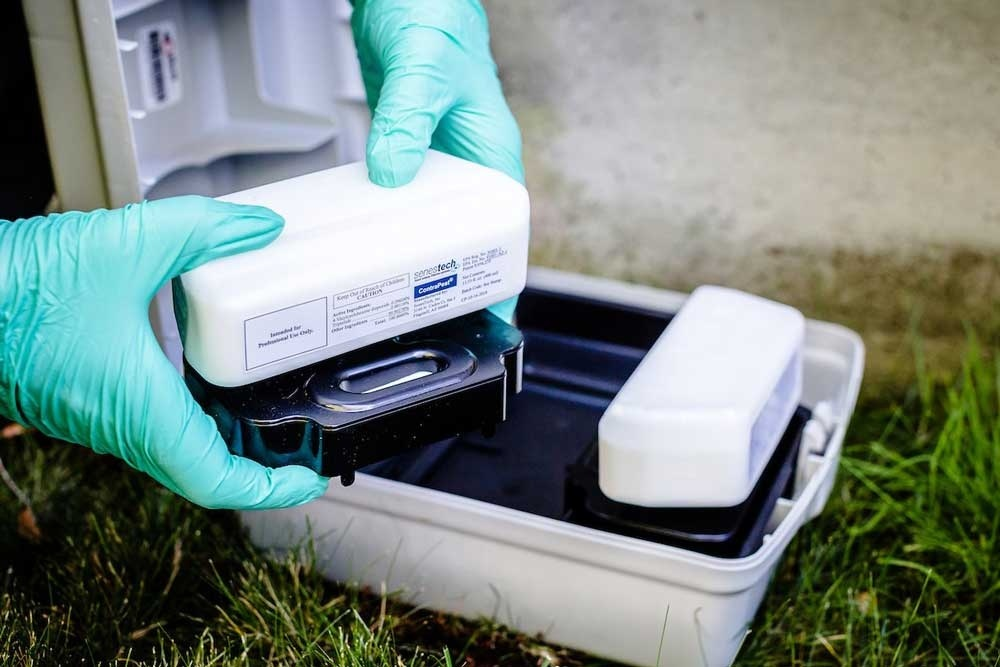
vs. Rat poison
Poison kills the rats that eat it. It doesn't stop the ones that come next.
Poison does its job. The problem is what happens four to six weeks after the colony clears. Empty territory in a food-rich urban block fills from the surrounding population — at full breeding rate — before your next scheduled treatment.
Where it works
It kills what's there. That part works.
Rodent poison placed along travel paths and near entry points will kill the rats that eat it. The colony that's currently active goes down. For light infestations or one-off incidents, it's often the right first tool.
The problem isn't what it does. The problem is what happens four to six weeks after it does it.
Where it falls short
Killing the colony makes the territory available.
Rats are territorial. When a colony is present, their scent markers keep other groups out. Remove that colony with poison and those marks fade within days. The food source didn't move. The building didn't move. Rats from the surrounding block detect the open territory and fill it within weeks.
The replacement colony comes in at full reproduction rate. You're back to baseline before the next scheduled visit.
Other problems with rodent poison
The cycle isn't the only issue.
Secondary kill risk
Hawks, owls, and foxes that eat poisoned rats absorb the toxicant. The strongest anticoagulant rodenticides carry the highest secondary risk and have been under increasing EPA restrictions for consumer use.
NYC restrictions
In 2021, NYC restricted commercial use of the strongest class of anticoagulant rodenticide. What was standard practice a few years ago is no longer on the approved list, and the list keeps changing.
It produces dead rats
Poison creates visible evidence — dead rodents in food storage, near prep surfaces, or where tenants find them. For restaurants, that's its own inspection and liability exposure even when the treatment is technically working.
How they compare
Poison and fertility management solve different parts of the problem.
| Rat poison | Fertility management ( Evolve) | |
|---|---|---|
| Kills the current colony | Yes | Phase 1 of the program handles this with your existing vendor |
| Reduces reproduction rate over time | No | Yes — that's the mechanism |
| Stops the replacement colony from forming | No | Reduces the rate at which it forms |
| Secondary kill risk | Yes — anticoagulants in particular | No — EPA-designated minimum risk |
| Safe for continuous food-environment use | Restricted | Yes |
| 90-day declining trend documentation | No | Monthly track count plates and written report |
The 90-day program uses both. Phase 1 clears the current colony with whatever treatment is already in place. Phase 2 adds Evolve on top to prevent the replacement from forming at the same rate. Together they produce a declining trend. Separately, neither does.
Field data
Numbers from monitored urban deployments.
What a combined program produces over 90 days.
More comparisons
See the layer next to the other tools you already use.
Keep the poison. Add the layer that stops the cycle.
The program works with whatever treatment is already running. Your vendor stays. We add the fertility layer on top.
- Layered onto your existing pest program
- EPA-designated minimum-risk bait
- Documented monthly reporting
- Month-to-month, no long contracts